How much does Driver AI cost?
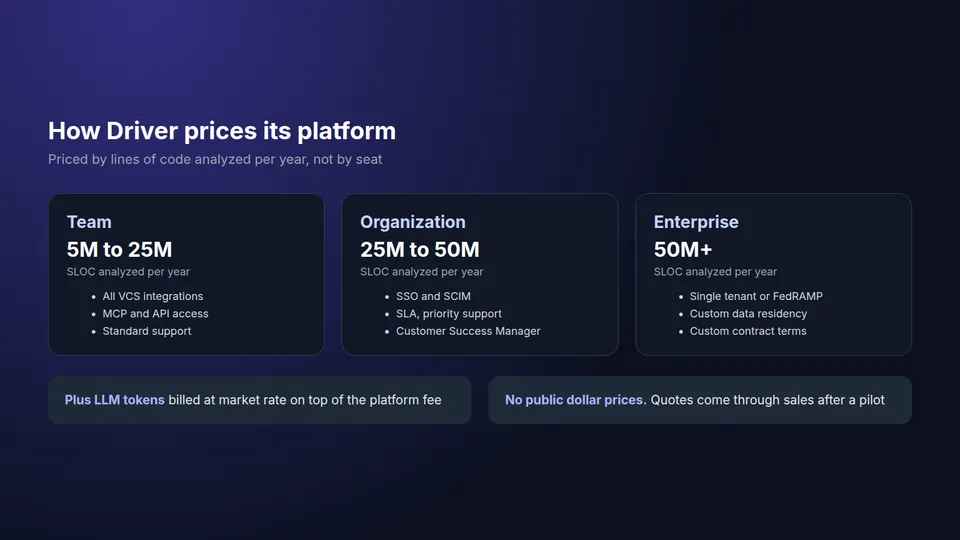
Driver AI does not publish dollar prices. Its pricing page at driver.ai/pricing sells three tiers sized by how much code Driver analyzes per year: Team for 5 million to 25 million source lines (SLOC), Organization for 25 million to 50 million, and Enterprise for 50 million and up. On top of the platform fee, the LLM tokens your account uses are billed at market rate. To get a number, you book a call and usually run a pilot first.
| Tier | SLOC analyzed per year | What it adds |
|---|---|---|
| Team | 5M to 25M | Full Driver platform, all code host integrations, MCP and API access, AI SDLC plugin, standard support |
| Organization | 25M to 50M | SSO and SCIM provisioning, priority support, onboarding assistance, SLA guarantees, a dedicated Customer Success Manager |
| Enterprise | 50M+ | Single-tenant or regulated deployment, FedRAMP and GovCloud options, custom data residency, custom contract terms |
Driver states the model in one line: priced by your code, not by seat. That is good news for a 300 person engineering org where seat licenses add up fast. It is less good news for a small team, as the next sections show.
What counts as a line of code in Driver's pricing?
Driver counts source lines by measuring bytes rather than newline characters. Its help center article on tracking usage says it counts the bytes in your source files and converts them to lines using a typical bytes per line ratio, so formatting style does not change your bill. Admins see current consumption under Settings, then Billing and Usage.
Two practical points follow. First, the unit is SLOC analyzed per year, not the size of your repo on a given day. Driver reprocesses scoped parts of the codebase when commits land, so ask during the sales call whether reprocessing counts toward the annual total and how branches are treated. Second, the meter covers what you connect. Leaving vendored code, generated clients and archived repos out of scope keeps the count down.
Driver AI pricing for a 10 to 50 person team
The smallest published tier starts at 5 million SLOC a year. Plenty of product companies with 10 to 50 engineers work in codebases that are a fraction of that, often a few hundred thousand to a couple of million lines across all repos. If that describes you, you would be buying into a tier sized for a larger estate, plus tokens, plus the time a pilot takes.
That does not make Driver a bad deal. It makes it a deal built for a different buyer: enterprises with large, polyglot, often legacy codebases on several code hosts, where pre-compiled documentation for every symbol saves real money. Driver also supports GitHub, GitLab, Bitbucket and Azure DevOps and offers single-tenant and FedRAMP deployments. A small GitHub team needs none of that.
| Your situation | Better fit | Why |
|---|---|---|
| Tens of millions of lines, several code hosts, compliance reviews | Driver | Pricing scales with code, deployment options cover regulated work |
| AI coding agents need deep context through MCP across a big estate | Driver | Pre-compiled, symbol-complete context is its core product |
| 5 to 50 people on GitHub who mostly need answers about the code | CodeIndex | Flat team price, self-serve signup, answers cite files and lines |
| Code must never leave your network | A self-hosted tool such as Sourcebot | Runs on your own servers |
Is there a cheaper alternative to Driver AI?
Yes, if your code lives on GitHub and the main job is answering questions about it. CodeIndex lets the whole team ask questions about your codebase in plain English and get answers that cite the exact files and line ranges. Pricing is published and flat per team:
| Plan | Price billed annually | Month to month | Includes |
|---|---|---|---|
| Starter | $49/mo | $99/mo | 5 users, 10 repos, 1,000 AI questions a month, 7-day audit log |
| Pro | $149/mo | $299/mo | 20 users, 50 repos, 10,000 AI questions, API access, 30-day audit log |
| Enterprise | $499/mo | $999/mo | Unlimited users and repos, 30,000 AI questions, SSO and SAML, 1-year audit log |
Every plan starts with a 14-day trial with Pro features, and there are no token charges on top. The honest trade-offs: CodeIndex supports GitHub only, has no on-premises option and does not generate the symbol-by-symbol documentation Driver is known for. If those are requirements, Driver or Sourcegraph is the right shortlist.
What should I ask Driver's sales team before signing?
Ask five things before you commit: the platform fee for your estimated SLOC, whether reprocessing after commits counts toward the annual total, an estimate of monthly token spend at your team's usage, what happens if you go over a tier mid-contract, and whether the pilot converts into a paid term automatically. Get the answers in writing. Once signed, keep the order form, SLOC limits and renewal date in contract management software that tracks renewal dates so the auto-renewal does not surprise finance next year.
Then compare the total with your alternatives over twelve months, not one. A token line that looks small in a pilot with three engineers can grow quickly once fifty people and several coding agents use it every day.
Driver vs CodeIndex for onboarding new engineers
Both products aim at the same pain: new hires and people switching projects lose days figuring out how the code works. Driver approaches it by generating structured documentation and architecture context ahead of time. CodeIndex approaches it with search and Q&A, so a new engineer asks "where is the signup flow?" and reads the cited code. For a team hiring a few engineers a quarter, the second approach usually covers the need at a known monthly cost. Our developer onboarding tool page walks through that setup, and the code intelligence platform comparison puts Driver-style tools next to search tools and coding assistants.
Other codebase tools and what they cost
If you are pricing the whole category, these are the published numbers we track:
- Sourcegraph: Enterprise only, starting at $16,000 a year. See our Sourcegraph pricing breakdown.
- Unblocked: $29 per user a month billed annually, $35 monthly, with Slack and Jira context. Details in Unblocked pricing.
- Sourcebot: free Basic and $20 per user a month for Pro, self-hosted.
- Swimm: no public tiers, priced by lines of code after a demo, now focused on mainframe and legacy modernization.
Two of these, Driver and Swimm, price by lines of code. That model rewards small codebases with large teams and punishes large codebases with small teams. Per-seat tools do the reverse. A flat team plan sidesteps both, which is why it tends to fit teams of 5 to 50 best.
Frequently asked questions
How much does Driver AI cost?
Driver AI does not list dollar prices. It sells Team (5M to 25M source lines analyzed per year), Organization (25M to 50M) and Enterprise (50M+) tiers by quote, and bills LLM tokens at market rate on top of the platform fee.
Does Driver AI charge per seat?
No. Driver prices by lines of code analyzed per year rather than by user, so adding engineers does not raise the platform fee. Token usage grows with how much people and agents use it, and that part is billed separately.
Does Driver AI have a free trial?
Driver does not advertise a self-serve free trial. Its process starts with a pilot, during which teams confirm value in the first two weeks before a contract. CodeIndex offers a self-serve 14-day trial with Pro features.
Which code hosts does Driver support?
Driver connects to GitHub, GitLab, Bitbucket and Azure DevOps and exposes context through MCP servers and a REST API. CodeIndex supports GitHub only.
What is a cheaper alternative to Driver AI for a small team?
For a GitHub team of 5 to 50 people that mainly needs codebase Q&A, CodeIndex costs a flat $49 a month for 5 users or $149 a month for 20 users billed annually, with answers that cite files and lines and no separate token bill.